A cellular automaton (pl. cellular automata, abbrev. CA) is a discrete model studied in computability theory, mathematics, physics, complexity science, theoretical biology and microstructure modeling. It consists of a regular grid of cells, each in one of a finite number of states, such as "On" and "Off" (in contrast to a coupled map lattice). 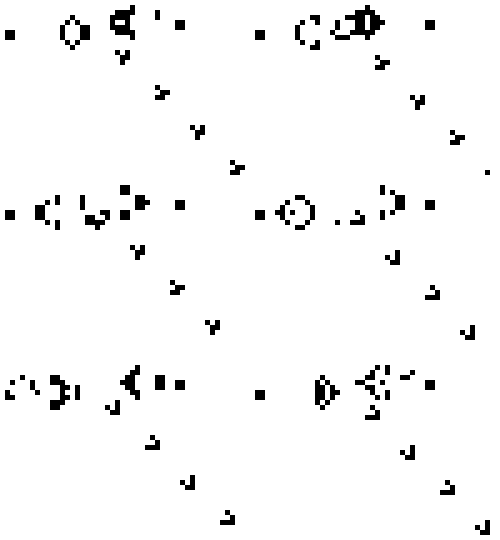 The grid can be in any finite number of dimensions. For each cell, a set of cells called its neighborhood (usually including the cell itself) is defined relative to the specified cell. For example, the neighborhood of a cell might be defined as the set of cells a distance of 2 or less from the cell. An initial state (time t=0) is selected by assigning a state for each cell. A new generation is created (advancing t by 1), according to some fixed rule (generally, a mathematical function) that determines the new state of each cell in terms of the current state of the cell and the states of the cells in its neighborhood. For example, the rule might be that the cell is "On" in the next generation if exactly two of the cells in the neighborhood are "On" in the current generation, otherwise the cell is "Off" in the next generation. Typically, the rule for updating the state of cells is the same for each cell and does not change over time, and is applied to the whole grid simultaneously, though exceptions are known.
Cellular automata are also called "cellular spaces", "tessellation automata", "homogeneous structures", "cellular structures", "tessellation structures", and "iterative arrays".
Overview
One way to simulate a two-dimensional cellular automaton is with an infinite sheet of graph paper along with a set of rules for the cells to follow. Each square is called a "cell" and each cell has two possible states, black and white. The "neighbors" of a cell are the 8 squares touching it. For such a cell and its neighbors, there are 512 (= 29) possible patterns. For each of the 512 possible patterns, the rule table would state whether the center cell will be black or white on the next time interval. Conway's Game of Life is a popular version of this model.
It is usually assumed that every cell in the universe starts in the same state, except for a finite number of cells in other states, often called a configuration. More generally, it is sometimes assumed that the universe starts out covered with a periodic pattern, and only a finite number of cells violate that pattern. The latter assumption is common in one-dimensional cellular automata.
 Cellular automata are often simulated on a finite grid rather than an infinite one. In two dimensions, the universe would be a rectangle instead of an infinite plane. The obvious problem with finite grids is how to handle the cells on the edges. How they are handled will affect the values of all the cells in the grid. One possible method is to allow the values in those cells to remain constant. Another method is to define neighbourhoods differently for these cells. One could say that they have fewer neighbours, but then one would also have to define new rules for the cells located on the edges. These cells are usually handled with a toroidal arrangement: when one goes off the top, one comes in at the corresponding position on the bottom, and when one goes off the left, one comes in on the right. (This essentially simulates an infinite periodic tiling, and in the field of partial differential equations is sometimes referred to as periodic boundary conditions.) This can be visualized as taping the left and right edges of the rectangle to form a tube, then taping the top and bottom edges of the tube to form a torus (doughnut shape). Universes of other dimensions are handled similarly. This is done in order to solve boundary problems with neighborhoods, but another advantage of this system is that it is easily programmable using modular arithmetic functions. For example, in a 1-dimensional cellular automaton like the examples below, the neighborhood of a cell xit—where t is the time step (vertical), and i is the index (horizontal) in one generation—is {xi−1t−1, xit−1, xi+1t−1}. There will obviously be problems when a neighbourhood on a left border references its upper left cell, which is not in the cellular space, as part of its neighborhood.
History
Stanisław Ulam, while working at the Los Alamos National Laboratory in the 1940s, studied the growth of crystals, using a simple lattice network as his model.[citation needed] At the same time, John von Neumann, Ulam's colleague at Los Alamos, was working on the problem of self-replicating systems. Von Neumann's initial design was founded upon the notion of one robot building another robot. This design is known as the kinematic model.[3][4] As he developed this design, von Neumann came to realize the great difficulty of building a self-replicating robot, and of the great cost in providing the robot with a "sea of parts" from which to build its replicant. Ulam suggested that von Neumann develop his design around a mathematical abstraction, such as the one Ulam used to study crystal growth.[citation needed] Thus was born the first system of cellular automata. Like Ulam's lattice network, von Neumann's cellular automata are two-dimensional, with his self-replicator implemented algorithmically. The result was a universal copier and constructor working within a CA with a small neighborhood (only those cells that touch are neighbors; for von Neumann's cellular automata, only orthogonal cells), and with 29 states per cell. Von Neumann gave an existence proof that a particular pattern would make endless copies of itself within the given cellular universe. This design is known as the tessellation model, and is called a von Neumann universal constructor.[citation needed]
Also in the 1940s, Norbert Wiener and Arturo Rosenblueth developed a cellular automaton model of excitable media.[5] Their specific motivation was the mathematical description of impulse conduction in cardiac systems. Their original work continues to be cited in modern research publications on cardiac arrhythmia and excitable systems.[6]
In the 1960s, cellular automata were studied as a particular type of dynamical system and the connection with the mathematical field of symbolic dynamics was established for the first time. In 1969, G. A. Hedlund compiled many results following this point of view[7] in what is still considered as a seminal paper for the mathematical study of cellular automata. The most fundamental result is the characterization of the set of global rules of cellular automata as the set of continuous endomorphisms of shift spaces.
In the 1970s a two-state, two-dimensional cellular automaton named Game of Life became very widely known, particularly among the early computing community. Invented by John Conway and popularized by Martin Gardner in a Scientific American article[citation needed], its rules are as follows: If a cell has 2 black neighbours, it stays the same. If it has 3 black neighbours, it becomes black. In all other situations it becomes white. Despite its simplicity, the system achieves an impressive diversity of behavior, fluctuating between apparent randomness and order. One of the most apparent features of the Game of Life is the frequent occurrence of gliders, arrangements of cells that essentially move themselves across the grid. It is possible to arrange the automaton so that the gliders interact to perform computations, and after much effort it has been shown that the Game of Life can emulate a universal Turing machine.[8] Possibly because it was viewed as a largely recreational topic, little follow-up work was done outside of investigating the particularities of the Game of Life and a few related rules.
In 1969, however, German computer pioneer Konrad Zuse published his book Calculating Space, proposing that the physical laws of the universe are discrete by nature, and that the entire universe is the output of a deterministic computation on a giant cellular automaton. This was the first book on what today is called digital physics.
In 1983 Stephen Wolfram published the first of a series of papers systematically investigating a very basic but essentially unknown class of cellular automata, which he terms elementary cellular automata (see below). The unexpected complexity of the behavior of these simple rules led Wolfram to suspect that complexity in nature may be due to similar mechanisms. Additionally, during this period Wolfram formulated the concepts of intrinsic randomness and computational irreducibility, and suggested that rule 110 may be universal—a fact proved later by Wolfram's research assistant Matthew Cook in the 1990s.
In 2002 Wolfram published a 1280-page text A New Kind of Science, which extensively argues that the discoveries about cellular automata are not isolated facts but are robust and have significance for all disciplines of science. Despite much confusion in the press and academia, the book did not argue for a fundamental theory of physics based on cellular automata, and although it did describe a few specific physical models based on cellular automata, it also provided models based on qualitatively different abstract systems.
Elementary cellular automata
The simplest nontrivial CA would be one-dimensional, with two possible states per cell, and a cell's neighbors defined to be the adjacent cells on either side of it. A cell and its two neighbors form a neighborhood of 3 cells, so there are 23=8 possible patterns for a neighborhood. A rule consists of deciding, for each pattern, whether the cell will be a 1 or a 0 in the next generation. There are then 28=256 possible rules. These 256 CAs are generally referred to by their Wolfram code, a standard naming convention invented by Stephen Wolfram which gives each rule a number from 0 to 255. A number of papers have analyzed and compared these 256 CAs. The rule 30 and rule 110 CAs are particularly interesting. The images below show the history of each when the starting configuration consists of a 1 (at the top of each image) surrounded by 0's. Each row of pixels represents a generation in the history of the automation, with t=0 being the top row. Each pixel is colored white for 0 and black for 1.
 Rule 30 cellular automaton
 Rule 110 cellular automaton
Rule 30 generates exhibits class 3 behavior, meaning even simple input patterns such as that shown lead to chaotic, seemingly random histories.
Rule 110, like the Game of Life, exhibits what Wolfram calls class 4 behavior, which is neither completely random nor completely repetitive. Localized structures appear and interact in various complicated-looking ways. In the course of the development of A New Kind of Science, as a research assistant to Stephen Wolfram in 1994, Matthew Cook proved that some of these structures were rich enough to support universality. This result is interesting because rule 110 is an extremely simple one-dimensional system, and one which is difficult to engineer to perform specific behavior. This result therefore provides significant support for Wolfram's view that class 4 systems are inherently likely to be universal. Cook presented his proof at a Santa Fe Institute conference on Cellular Automata in 1998, but Wolfram blocked the proof from being included in the conference proceedings, as Wolfram did not want the proof to be announced before the publication of A New Kind of Science. In 2004, Cook's proof was finally published in Wolfram's journal Complex Systems (Vol. 15, No. 1), over ten years after Cook came up with it. Rule 110 has been the basis over which some of the smallest universal Turing machines have been built, inspired on the breakthrough concepts that the development of the proof of rule 110 universality produced.
 The grid can be in any finite number of dimensions. For each cell, a set of cells called its neighborhood (usually including the cell itself) is defined relative to the specified cell. For example, the neighborhood of a cell might be defined as the set of cells a distance of 2 or less from the cell. An initial state (time t=0) is selected by assigning a state for each cell. A new generation is created (advancing t by 1), according to some fixed rule (generally, a mathematical function) that determines the new state of each cell in terms of the current state of the cell and the states of the cells in its neighborhood. For example, the rule might be that the cell is "On" in the next generation if exactly two of the cells in the neighborhood are "On" in the current generation, otherwise the cell is "Off" in the next generation. Typically, the rule for updating the state of cells is the same for each cell and does not change over time, and is applied to the whole grid simultaneously, though exceptions are known.
Cellular automata are also called "cellular spaces", "tessellation automata", "homogeneous structures", "cellular structures", "tessellation structures", and "iterative arrays".
Overview
One way to simulate a two-dimensional cellular automaton is with an infinite sheet of graph paper along with a set of rules for the cells to follow. Each square is called a "cell" and each cell has two possible states, black and white. The "neighbors" of a cell are the 8 squares touching it. For such a cell and its neighbors, there are 512 (= 29) possible patterns. For each of the 512 possible patterns, the rule table would state whether the center cell will be black or white on the next time interval. Conway's Game of Life is a popular version of this model.
It is usually assumed that every cell in the universe starts in the same state, except for a finite number of cells in other states, often called a configuration. More generally, it is sometimes assumed that the universe starts out covered with a periodic pattern, and only a finite number of cells violate that pattern. The latter assumption is common in one-dimensional cellular automata.
History
Stanisław Ulam, while working at the Los Alamos National Laboratory in the 1940s, studied the growth of crystals, using a simple lattice network as his model.[citation needed] At the same time, John von Neumann, Ulam's colleague at Los Alamos, was working on the problem of self-replicating systems. Von Neumann's initial design was founded upon the notion of one robot building another robot. This design is known as the kinematic model.[3][4] As he developed this design, von Neumann came to realize the great difficulty of building a self-replicating robot, and of the great cost in providing the robot with a "sea of parts" from which to build its replicant. Ulam suggested that von Neumann develop his design around a mathematical abstraction, such as the one Ulam used to study crystal growth.[citation needed] Thus was born the first system of cellular automata. Like Ulam's lattice network, von Neumann's cellular automata are two-dimensional, with his self-replicator implemented algorithmically. The result was a universal copier and constructor working within a CA with a small neighborhood (only those cells that touch are neighbors; for von Neumann's cellular automata, only orthogonal cells), and with 29 states per cell. Von Neumann gave an existence proof that a particular pattern would make endless copies of itself within the given cellular universe. This design is known as the tessellation model, and is called a von Neumann universal constructor.[citation needed]
Also in the 1940s, Norbert Wiener and Arturo Rosenblueth developed a cellular automaton model of excitable media.[5] Their specific motivation was the mathematical description of impulse conduction in cardiac systems. Their original work continues to be cited in modern research publications on cardiac arrhythmia and excitable systems.[6]
In the 1960s, cellular automata were studied as a particular type of dynamical system and the connection with the mathematical field of symbolic dynamics was established for the first time. In 1969, G. A. Hedlund compiled many results following this point of view[7] in what is still considered as a seminal paper for the mathematical study of cellular automata. The most fundamental result is the characterization of the set of global rules of cellular automata as the set of continuous endomorphisms of shift spaces.
In the 1970s a two-state, two-dimensional cellular automaton named Game of Life became very widely known, particularly among the early computing community. Invented by John Conway and popularized by Martin Gardner in a Scientific American article[citation needed], its rules are as follows: If a cell has 2 black neighbours, it stays the same. If it has 3 black neighbours, it becomes black. In all other situations it becomes white. Despite its simplicity, the system achieves an impressive diversity of behavior, fluctuating between apparent randomness and order. One of the most apparent features of the Game of Life is the frequent occurrence of gliders, arrangements of cells that essentially move themselves across the grid. It is possible to arrange the automaton so that the gliders interact to perform computations, and after much effort it has been shown that the Game of Life can emulate a universal Turing machine.[8] Possibly because it was viewed as a largely recreational topic, little follow-up work was done outside of investigating the particularities of the Game of Life and a few related rules.
In 1969, however, German computer pioneer Konrad Zuse published his book Calculating Space, proposing that the physical laws of the universe are discrete by nature, and that the entire universe is the output of a deterministic computation on a giant cellular automaton. This was the first book on what today is called digital physics.
In 1983 Stephen Wolfram published the first of a series of papers systematically investigating a very basic but essentially unknown class of cellular automata, which he terms elementary cellular automata (see below). The unexpected complexity of the behavior of these simple rules led Wolfram to suspect that complexity in nature may be due to similar mechanisms. Additionally, during this period Wolfram formulated the concepts of intrinsic randomness and computational irreducibility, and suggested that rule 110 may be universal—a fact proved later by Wolfram's research assistant Matthew Cook in the 1990s.
In 2002 Wolfram published a 1280-page text A New Kind of Science, which extensively argues that the discoveries about cellular automata are not isolated facts but are robust and have significance for all disciplines of science. Despite much confusion in the press and academia, the book did not argue for a fundamental theory of physics based on cellular automata, and although it did describe a few specific physical models based on cellular automata, it also provided models based on qualitatively different abstract systems.
Elementary cellular automata
The simplest nontrivial CA would be one-dimensional, with two possible states per cell, and a cell's neighbors defined to be the adjacent cells on either side of it. A cell and its two neighbors form a neighborhood of 3 cells, so there are 23=8 possible patterns for a neighborhood. A rule consists of deciding, for each pattern, whether the cell will be a 1 or a 0 in the next generation. There are then 28=256 possible rules. These 256 CAs are generally referred to by their Wolfram code, a standard naming convention invented by Stephen Wolfram which gives each rule a number from 0 to 255. A number of papers have analyzed and compared these 256 CAs. The rule 30 and rule 110 CAs are particularly interesting. The images below show the history of each when the starting configuration consists of a 1 (at the top of each image) surrounded by 0's. Each row of pixels represents a generation in the history of the automation, with t=0 being the top row. Each pixel is colored white for 0 and black for 1.

current pattern | 111 | 110 | 101 | 100 | 011 | 010 | 001 | 000 |
|---|---|---|---|---|---|---|---|---|
| new state for center cell | 0 | 0 | 0 | 1 | 1 | 1 | 1 | 0 |

| current pattern | 111 | 110 | 101 | 100 | 011 | 010 | 001 | 000 |
|---|---|---|---|---|---|---|---|---|
| new state for center cell | 0 | 1 | 1 | 0 | 1 | 1 | 1 | 0 |
Rule 30 generates exhibits class 3 behavior, meaning even simple input patterns such as that shown lead to chaotic, seemingly random histories.
Rule 110, like the Game of Life, exhibits what Wolfram calls class 4 behavior, which is neither completely random nor completely repetitive. Localized structures appear and interact in various complicated-looking ways. In the course of the development of A New Kind of Science, as a research assistant to Stephen Wolfram in 1994, Matthew Cook proved that some of these structures were rich enough to support universality. This result is interesting because rule 110 is an extremely simple one-dimensional system, and one which is difficult to engineer to perform specific behavior. This result therefore provides significant support for Wolfram's view that class 4 systems are inherently likely to be universal. Cook presented his proof at a Santa Fe Institute conference on Cellular Automata in 1998, but Wolfram blocked the proof from being included in the conference proceedings, as Wolfram did not want the proof to be announced before the publication of A New Kind of Science. In 2004, Cook's proof was finally published in Wolfram's journal Complex Systems (Vol. 15, No. 1), over ten years after Cook came up with it. Rule 110 has been the basis over which some of the smallest universal Turing machines have been built, inspired on the breakthrough concepts that the development of the proof of rule 110 universality produced.
Comments
Post a Comment